
Your Attention Isn't Broken
What 200 world-class performers know about attention, what the lab data shows, and one hour in Bondi on 20 June

Tim Ferriss has interviewed somewhere north of two hundred people at the top of their fields. Athletes. Investors. Generals. Writers. After about a hundred conversations he noticed a thing he didn't expect, and he kept noticing it. More than 80% of them had a daily mindfulness or meditation practice [1]. He said it surprised him every time, which is the only honest thing to say about it. The 80% line gets passed around as a productivity hack now, which is a small tragedy. What's interesting isn't the number. It's the question underneath it. What do people who get to the top of their work know about attention that the rest of us are missing?
Most of the writing about focus starts from the assumption that your attention is broken. That something is wrong with you. The phone did it, or the algorithm did it, or your childhood did it, or you've got some flavour of ADHD nobody diagnosed. The fix on offer is always external. An app, a supplement stack, a dopamine fast, blue-light glasses, a productivity system named after a tomato or a four-letter Japanese word. The premise underneath the whole industry is that you are the patient and someone else has the cure.
Your attention is fine. It's working exactly the way evolution designed it to. Whatever is loudest in your environment, your attention goes there. The pings get checked. The system isn't broken. It's been pointed.
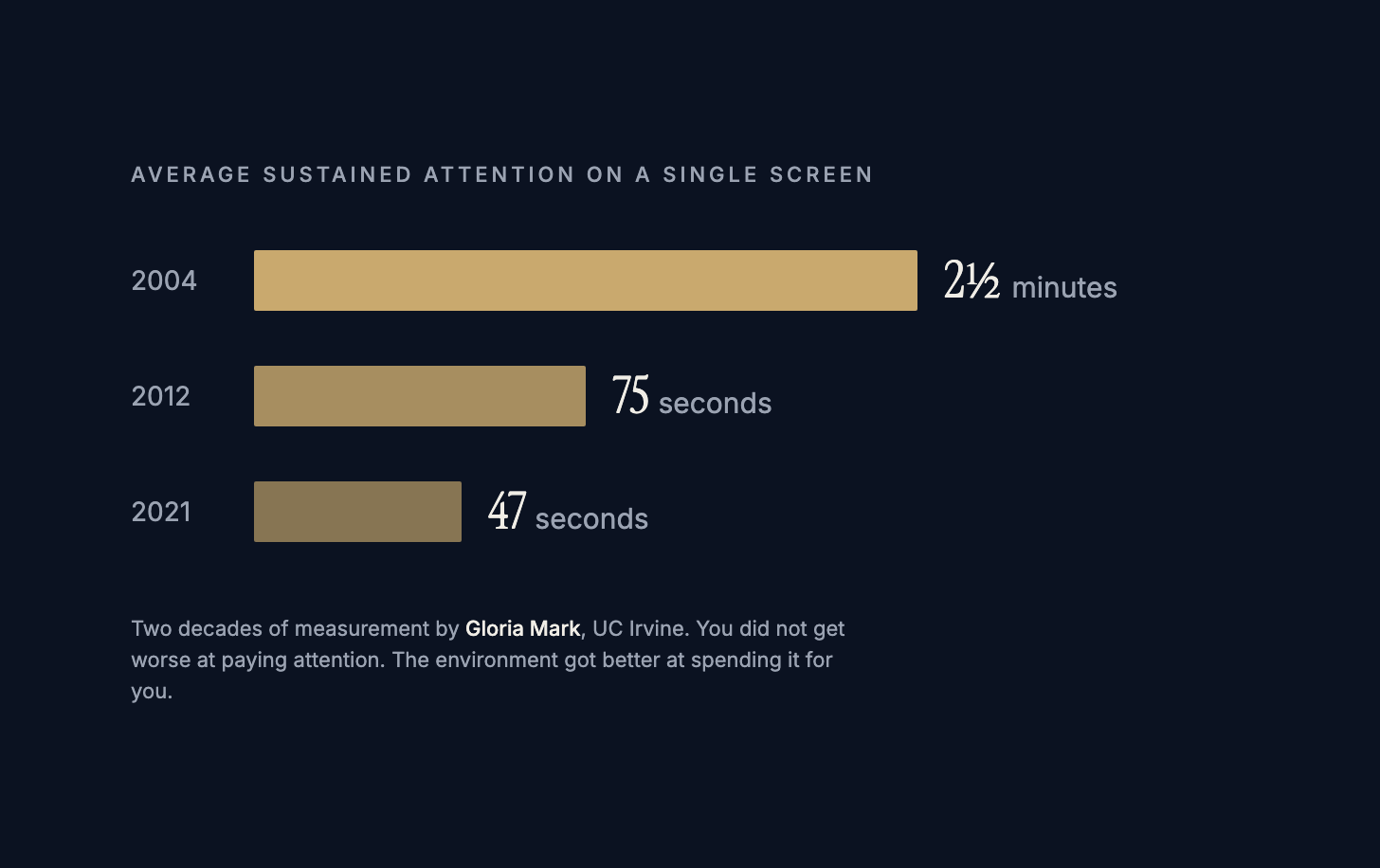
Gloria Mark runs the attention lab at UC Irvine. She has been measuring how knowledge workers spend their attention for two decades. In 2004 she clocked average sustained attention on a single screen at about two and a half minutes. By 2012 it was 75 seconds. By 2021 it was 47 seconds [2]. The collapse happened inside your working life. You did not get worse at paying attention. The environment got better at spending it for you.
Mark's other famous number is 23 minutes and 15 seconds. That's the average time it takes to get back to the task you were doing before a single interruption [3]. Not to refocus. Just to remember where you were. A phone buzz at 10:14am means whatever you were doing at 10:13 is gone until at least 10:37, and that's if nothing else interrupts you in between. The math, played out across a day, is the reason most of your week feels like running on a treadmill that is also on fire.
This is not a defect in you. This is a feature of an attention market that runs on extracting fractions of a second from a billion people. The slot-machine architecture inside your phone wasn't an accident. The variable-reward schedules in social-media apps were borrowed straight from casino design. You are not weak-willed. You are a mammal being pointed at.
The good news, if there is any, is that attention is a capacity, not a fixed quantity. It can be trained the way a muscle can be trained. There are studies on this; short ones and long ones, on monks and on Marines, on surgeons and on sales reps. Yi-Yuan Tang's group at Dalian University found that five days of brief meditation training improved scores on the Attention Network Test [4]. Five days. The signal is small but real, and the larger meta-analyses (Goyal 2014 [5] is the cleanest hedge here) find moderate effects on anxiety, depression and pain rather than the breakthrough claims sometimes made for the practice. Treat the science as confirmation that something is there, not as the reason to sit.
I should name a thing before I keep going. I'm a coach. My livelihood depends on this kind of argument mattering. That's exactly why you should pressure-test it. Read the citations. Run a Saturday sit yourself before you take anyone's word for any of this, including mine.
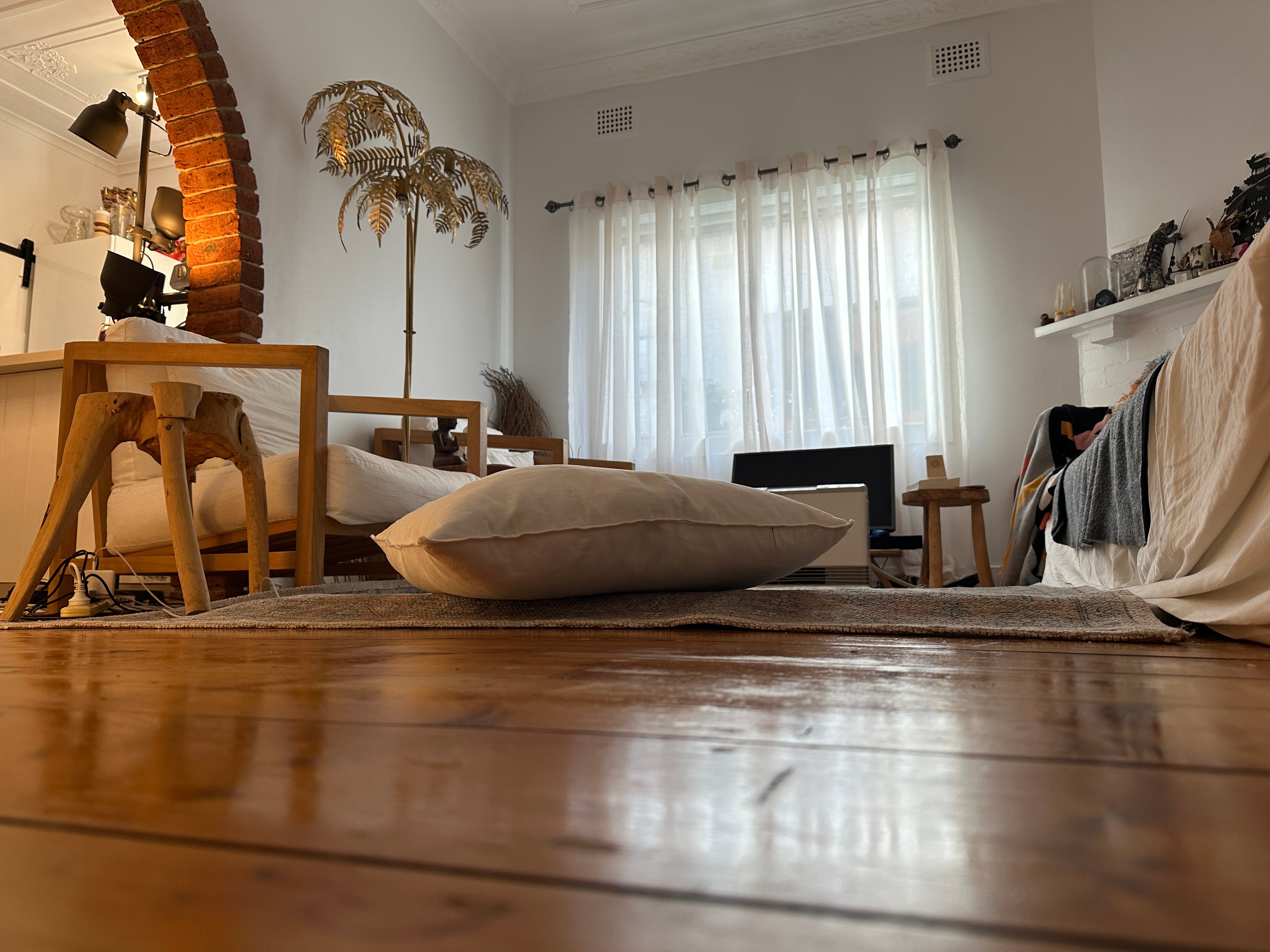
So this is what the Saturday Sit is, and what it isn't. It isn't a fix for what's wrong with you. Nothing is wrong with you. It is one hour of attention training, in a room in Bondi, with twenty other people who decided the same thing on the same Saturday. The room is the instrument. Twenty people deciding to stay is harder to walk out on than one person deciding alone. The phone is in a basket by the door. The bell rings at 1pm. Nobody talks. You sit. You notice what your attention does. You come back. You do it again. You do it a thousand times in an hour.
There is one thing I want to be careful about saying. The point of sitting is not to engineer a better version of yourself. Pema Chödrön, who has been writing about this for forty years, would push back hard on anyone who framed practice that way. The mind doesn't get quiet. You don't transcend anything. You don't escape your life. What changes, slowly and without fanfare, is that you become slightly less interested in the noise. The thoughts still arrive. You're less likely to chase every one out the door. That's most of what people end up calling equanimity, and it's smaller than the marketing suggests.
I sat this morning at 6:30am. I'd been awake since 5:45 doing what most of us do, which is reaching for the phone before getting out of bed. Nothing on it. Nothing waiting. Just the small pull of wanting something to grab me. I counted the reaches once I noticed them. Nine, before I sat down on the cushion. The morning sit didn't fix the reaching. It made me see the reaching, which is most of what sitting ever does. The seeing is the practice. Whether I reach less tomorrow is a side effect.
If you've read this far the practical version is short. Saturday 20 June 2026, 1pm to 2:30pm, BodyMindLife in Bondi. Twenty seats. $15 until midnight on Friday 19 June, $40 after that. luma.com/5pfeuysh. There's no follow-up sequence, no upsell, no course. After the hour we put the chairs back and walk out. The whole thing takes the afternoon out of your Saturday and gives you back a slightly less reactive Monday. That's the honest claim, and the only one I'm willing to make in writing.
The bet is small. The asymmetry is large. One hour against the rest of an operating life spent half-present.
Attention is a capacity you already have. Most of the time you're using it on whatever grabs you. One hour of sitting is how you take it back. Not by tightening. By noticing.
Sources
[1] Tim Ferriss, Tools of Titans, Houghton Mifflin Harcourt (2016). Ferriss's introduction to the book notes that more than 80% of the world-class performers he has interviewed have some form of daily mindfulness or meditation practice. Sample drawn from ~200 interviews on The Tim Ferriss Show. Original post: https://tim.blog/2015/12/14/meditation/
[2] Gloria Mark, Attention Span: A Groundbreaking Way to Restore Balance, Happiness and Productivity, Hanover Square Press (2023). UC Irvine: https://news.uci.edu/2023/02/02/attention-spans-while-working-in-front-of-a-computer-getting-shorter/
[3] Mark, G., Gudith, D., & Klocke, U. (2008). "The Cost of Interrupted Work: More Speed and Stress." Proceedings of CHI 2008, ACM. Average time to return to the original task after an interruption: 23 minutes and 15 seconds. https://www.ics.uci.edu/~gmark/chi08-mark.pdf
[4] Tang, Y.-Y., Ma, Y., Wang, J., et al. (2007). "Short-term meditation training improves attention and self-regulation." Proceedings of the National Academy of Sciences, 104(43), 17152–17156. https://www.pnas.org/doi/10.1073/pnas.0707678104
[5] Goyal, M., Singh, S., Sibinga, E. M. S., et al. (2014). "Meditation Programs for Psychological Stress and Well-being: A Systematic Review and Meta-analysis." JAMA Internal Medicine, 174(3), 357–368. Meta-analysis of 47 trials (3,515 participants); moderate evidence for anxiety, depression and pain reduction, less for other outcomes. The cleanest hedge against breakthrough claims. https://jamanetwork.com/journals/jamainternalmedicine/fullarticle/1809754
Great post. Started meditating "officially" at the start of the year, took 2 months off (urgh) and now I'm back at it after a slump. Missed it.