Confidence Is a Terrible Interview Signal
The candidate who fills the room is telling you less than you think

The most confident person in your final interview round is often the most fragile hire on your shortlist.
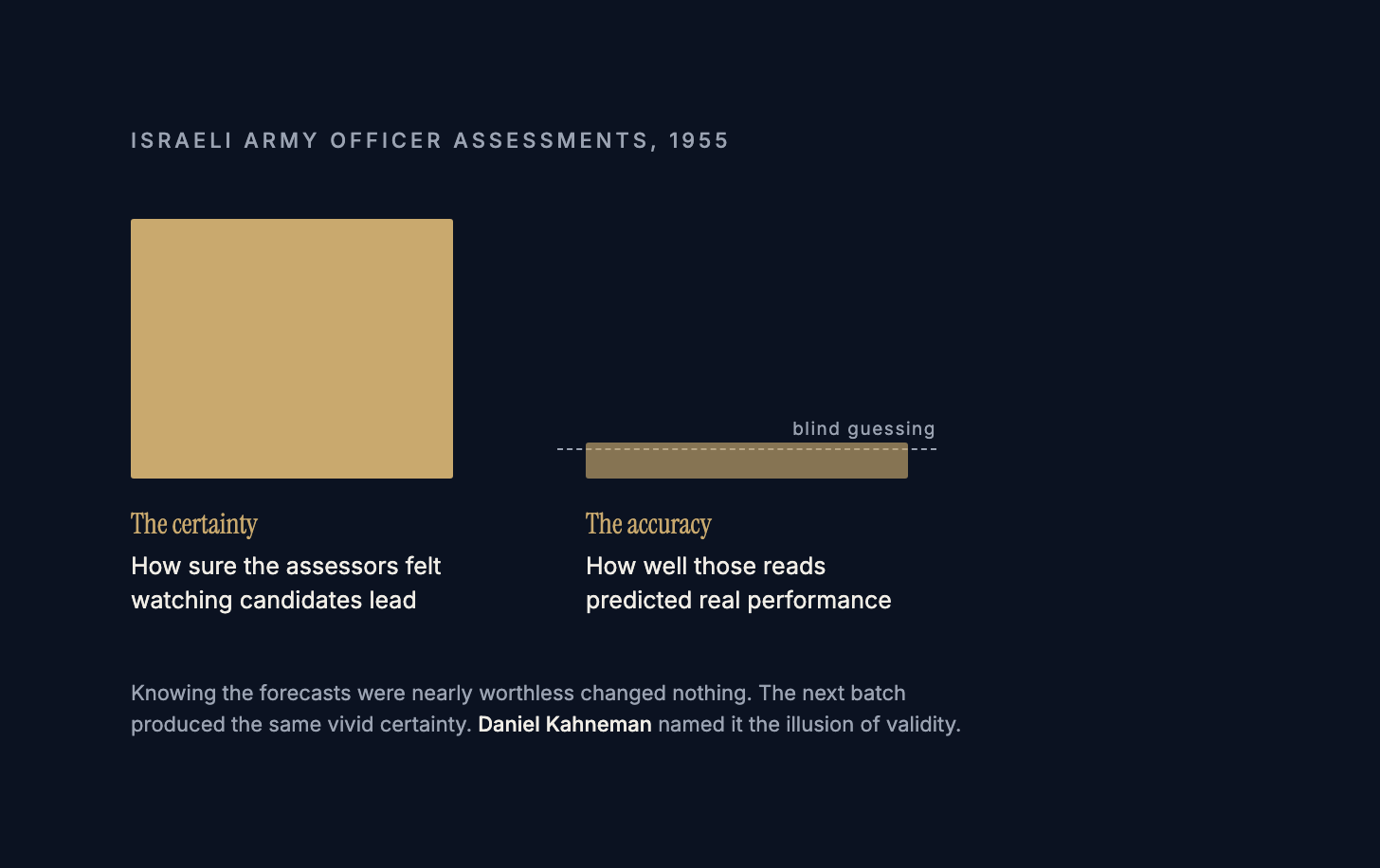
In 1955, a 21-year-old psychologist was assessing officer candidates for the Israeli army. The test was a leaderless group challenge: eight strangers, a log, a wall to get it over. Watching who took charge, he felt vivid certainty about who would make a real officer. Then the follow-up statistics came back from officer school, and his predictions were barely better than guessing. Here is the part that should worry every founder and CEO who trusts their read of a final-round interview: knowing his forecasts were nearly worthless changed nothing. The next batch of candidates produced the same vivid certainty, with the same feeling of seeing the truth about a person. The psychologist was Daniel Kahneman, and he later gave the error a name that stuck: the illusion of validity.
A founder I work with lived this from the hiring side. He was filling a critical technical seat. One candidate had presence, fluency, answers that landed like they'd been rehearsed in front of a mirror because they had been. Another candidate hedged, poked holes in the company's plans, and came across as flatly negative. The founder nearly passed on him.
Hold that decision for a moment, because what happened next only makes sense once you see what an interview actually measures. The format rewards one specific skill: performing certainty in front of strangers for an hour. That would be fine if performing certainty had anything to do with the job. It doesn't, and on the days that matter most it runs backwards.
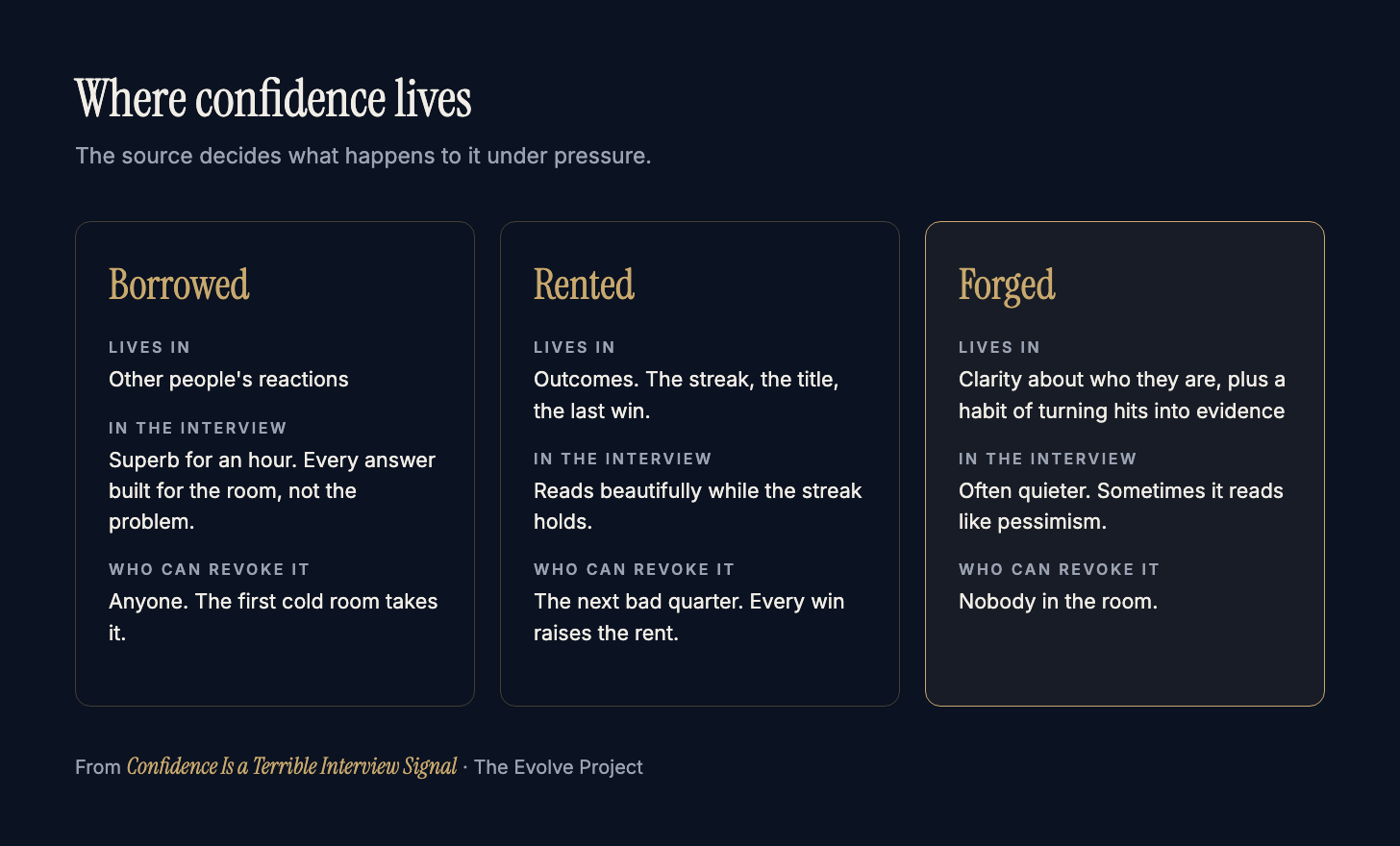
What you are actually trying to read across that table is where a person's confidence comes from, because the source decides what happens to them under pressure. Confidence comes from three places.
Borrowed confidence lives in other people's reactions. An interview is its home game: a room full of strangers to win over is exactly the fuel it runs on. The rehearsed candidate was running on it in front of the founder's eyes, every answer built for the room rather than the problem. It looks superb for an hour and goes missing the first week the room turns cold.
Rented confidence lives in outcomes. The streak, the title, the last win. It reads beautifully right up until the streak ends, and then the same person who filled your boardroom can't send an email. Every win raises the rent.
Forged confidence is built from two things nobody in that room controls: clarity about who they are, and a practiced habit of turning hits into evidence. It often reads quieter than the other two. Sometimes it reads like pessimism.
The founder hired the pessimist. That apparently negative candidate became the best hire he has made: relentlessly open, hungry for feedback, treating every correction as information rather than insult. The pessimism turned out to be the surface of something valuable, a mind that refused to perform certainty it hadn't earned yet. The display had been telling the founder almost nothing. The source told him everything that mattered.
So how do you interview for the source instead of the display? The richest seam is the candidate's worst professional loss, and specifically the weeks after it. Listen to what they describe. People running on rented confidence describe the event: what happened, what was done to them, whose fault it was. People with forged confidence describe their response, usually with a date or a number attached. "It took me about two weeks to get my legs back, and then I rebuilt the pipeline from scratch" tells you more than every strengths question ever written.
There's a second move, one I now hand to every founder who will take it: flip the format entirely. Skip the question list. Tell the candidate exactly what you're building, put one live problem in front of them, the one that's actually keeping you up, and watch what they do with it. The response under live conditions is the interview. Prepared certainty never gets a chance to perform.
Kahneman's own fix is the part that travels. He didn't stop assessing candidates; he governed the assessment. Dimensions chosen before the interview, factual questions, each trait scored on its own, intuition allowed in only after the scores were down. His interviewers told him he was turning them into robots. The army used the method for decades. A work trial works the same way: decide what you're scoring before you watch, or the watching will write the story for you.
I should declare an interest here. I coach confidence for a living, which makes me roughly the last person who should tell you to ignore it in an interview. So I'll be precise about the claim: the display tells you almost nothing, and the source tells you most of what you need. One is free to fake for an hour. The other leaks out in how a person talks about their worst year.
The candidate who ran the room is confident today. The interview can't tell you whether he'll still be confident the week your biggest client walks. The answer to that question exists, and it's sitting in his history, in what he did across the fortnight after the worst thing that ever happened to his work. You just have to ask for it.
What did your best hire look like in their interview?